


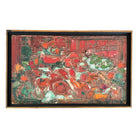
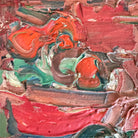
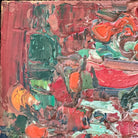
Still Life Painting "Poivrons et Tomates" by André Cottavoz (1922-2022)
Recogida disponible en ByCloudia Austin
Normalmente está listo en 24 horas
9 1/2” x 16 1/4” Framed: 10 1/2” x 17 1/4”
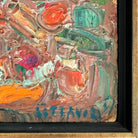
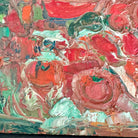
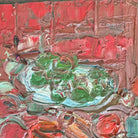
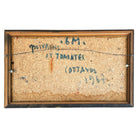
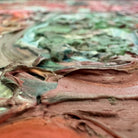
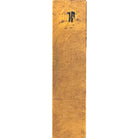
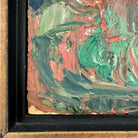
Housed in its original, age-toned mid-century gallery frame, this vibrant 1967 oil-on-board still life by André Cottavoz, transforms a traditional culinary motif into a high-relief, sculptural exploration of light and form. Titled Poivrons et Tomates and painted in Antibes, France, the composition vibrates with a dense arrangement of rich, earthy reds, terracotta tones, and flashes of cool, viridian green, all rendered through a thick, expressive impasto that blurs the lines between representation and pure abstraction. Cottavoz’s signature lifelong approach to treating paint as a three-dimensional medium—famously sparked at age fourteen when he was so struck by a Vincent van Gogh landscape in a shop window that he rushed home to replicate it using a kitchen knife—is fully realized here; he explicitly described his process as "almost sculpting," building, kneading, and layering the pigment with a brush, knife, and his bare hands to let raw emotion dictate the canvas. This carnal, heavily knifed texture directly embodies the philosophy of the Sanzisme (or Noisme) movement, which Cottavoz co-founded in Lyon in 1948 alongside student peers from the École des Beaux-Arts to reject academic constraints and reigning mid-century abstract trends. Meaning "without an -ism," Sanzisme championed the freedom to paint "in the light," declaring that light should not merely illuminate a subject from the outside, but violently gush from the physical depth of the paint itself. In Poivrons et Tomates, this manifests as structural forms of produce carved directly into the heavy pigment, catching ambient light to cast natural micro-shadows across the panel. Born in Saint-Marcellin, Cottavoz weathered wartime forced labor in Austria through the salvation of his art before returning to lead the Lyon School of New Figuration, ultimately gaining elite validation with the University of Paris’s Fénéon Prize in 1953 and lasting international success through legendary Japanese dealer Kiyoshi Tamenaga. Today, while the piece exhibits minor wear to its frame and historical water damage visible exclusively on the paper backing of the reverse side, the face of the painting remains magnificent and highly stable on its sturdy board support, serving as a powerful testament to an artist who successfully merged the raw gravity of Chaim Soutine with the brilliant, sun-baked radiance of the French Riviera.
Antibes, France
1967
